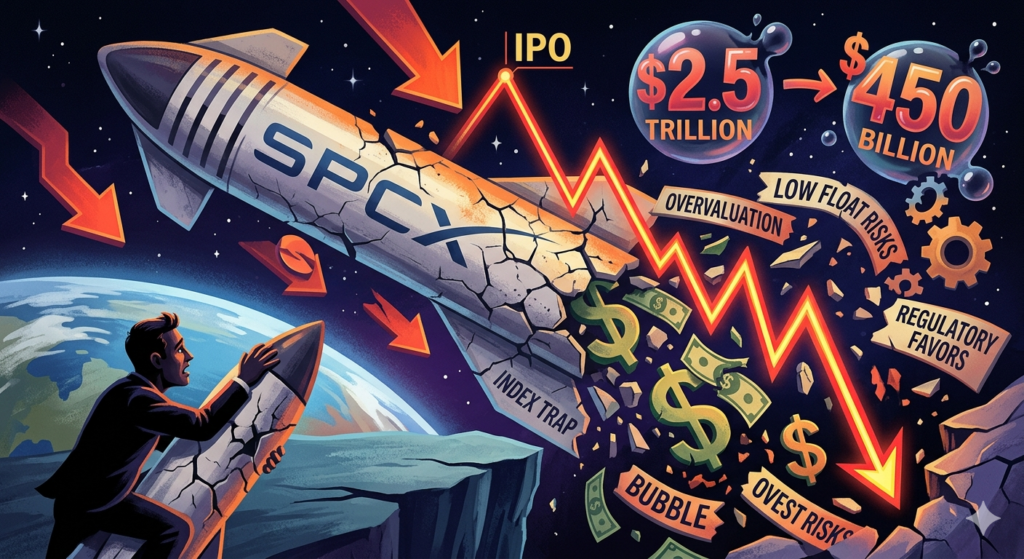
The Nasdaq debut of SpaceX (ticker: SPCX) has been portrayed by mainstream media as the financial event of the century. Amid celebratory headlines marking its surge past the $2 trillion market cap milestone and the coronation of Elon Musk as history’s first “trillionaire,” retail investor FOMO (Fear Of Missing Out) has reached dangerous levels.
But once you scrape away the gold paint of the sci-fi narrative, what remains is one of the most asymmetric and hazardous financial bets ever seen. As rational investors, the smartest move right now is to steer clear of SpaceX. Here is why.
1. Mirage Multiples: Revenue vs. Valuation
Let’s start with the cold, hard numbers—the ones that always drive markets in the long run.
In 2025, SpaceX reported revenues of approximately $15-18 billion, closing the fiscal year in the red (with a consolidated net loss of about $4.9 billion, driven largely by heavy merger expenses with the remnants of xAI and X). For 2026, the most optimistic forecasts project revenues between $23 and $25 billion, primarily fueled by Starlink subscriptions.
With a floating market capitalization that surpassed $2.5 trillion in its first trading days, we are looking at a Price-to-Sales (P/S) multiple of over 100x.
- For context: even Big Tech giants and semiconductor leaders at the absolute peak of the AI hype trade at P/S multiples between 20x and 35x.
- Wall Street is currently pricing in a sci-fi scenario formulated by Morgan Stanley, which projects $3.4 trillion in revenue by 2040. Buying a stock today based on cash flows estimated 14 years from now isn’t investing—it’s clairvoyance (or gambling).
2. The “Trick” of the Ultra-Low Free Float
A technical factor that many retail investors are completely overlooking is the stock’s actual free float. SpaceX went public with a ridiculously low free float: barely 3% to 4% of total shares are actually available for public trading. Everything else is locked up in the hands of Musk (who controls 42%), sovereign wealth funds, and early-stage institutional investors.
Such a tiny free float creates artificial scarcity. When initial demand is sky-high and supply is minuscule, the price skyrockets with zero correlation to the company’s intrinsic value. As soon as insiders begin to liquidate their stakes to cash out, market supply will surge, and the downward pressure will be violent.
3. Shifting the Goalposts: Regulatory Favors from the Government and Nasdaq
If you are wondering how a newly listed company managed to enter the baskets of major global indices almost instantaneously, the answer lies at the intersection of geopolitics and economics: the rules of the game were changed.
Traditionally, to join prestigious indices like the Nasdaq 100, a company must meet strict criteria regarding listing longevity (often at least one year) and stringent profitability requirements. However, Nasdaq and major index providers like FTSE Russell amended their operational guidelines to grant SpaceX an accelerated “fast-track” inclusion just days after its IPO.
This unprecedented move has sparked heavy political backlash, including inquiries from the US Senate Banking Committee. In essence, regulatory institutions bent historical market safeguards just to avoid losing the largest listing in history to private markets or foreign exchanges.
4. The Trap for Index Funds (ETFs) and Pension Funds
This rule-breaking creates a massive systemic risk for anyone holding a Nasdaq ETF or a private pension fund.
By mandate, passive funds must replicate the index. Because SpaceX was aggressively pushed into the basket based on its massive theoretical market cap, ETF managers were forced to buy billions of dollars worth of SPCX shares regardless of price, further inflating the bubble.
The paradox? If the actual free float increases in the future (say, to 50%), ETFs will be automatically forced to absorb roughly $200 billion worth of SpaceX shares. This will drain liquidity away from healthy, profitable, and undervalued companies just to pump it into a highly volatile asset.
Our Realistic Valuation: What is SpaceX Actually Worth?
If we strip away the hype about Mars voyages, lunar colonization, and orbital data center networks powered by AI—projects that require staggering capital expenditure and offer highly uncertain returns—what are we left with? We have an excellent aerospace launch provider (Falcon 9 and Starship) and a top-tier satellite internet provider (Starlink) that is beginning to generate interesting margins.
By applying traditional valuation models based on a Sum-of-the-Parts analysis and aggressive yet realistic multiples for the tech/SaaS sector (around 20x-25x on current sales), we get a vastly different picture:
🎯 Our Target Price: $50 per share
While the market price wildly fluctuates past $180, we believe the stock’s fundamental and realistic value hovers around $50, translating to a fair market capitalization between $450 billion and $550 billion. Anything above that is a “Musk premium” and pure speculation.
The Bottom Line
Investing in SpaceX at current price levels means accepting an unjustified level of risk. Are you ready to fund Musk’s Mars campaign with your savings, knowing that market rules were rigged to force you to buy at the absolute top? For now, we prefer to watch this launch from the safety of the ground.