
If there is one acronym that makes the hearts of dividend-focused and capital-growth investors skip a beat, it is SCHD (Schwab U.S. Dividend Equity ETF). In recent years, this fund has become a true legend within the global financial community. However, for an investor living in Europe, getting direct access to it has become nearly impossible.
In this article, we will analyze SCHD’s success, its historical performance, the regulatory reasons why it is unavailable in the Old Continent, and the best alternatives compliant with European regulations.
1. What Is SCHD and Why Has It Conquered the World?
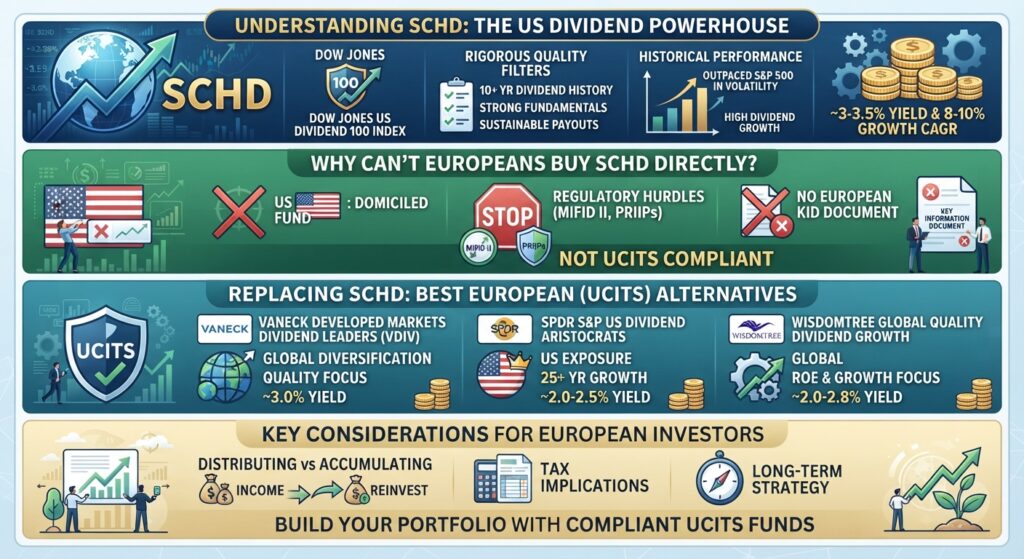
Managed by Charles Schwab, the SCHD ETF does not simply look for companies paying the absolute highest dividends (a strategy often risky and prone to so-called yield traps). Instead, the fund tracks the Dow Jones U.S. Dividend 100 Index, imposing extremely rigorous quality filters:
- Dividend History: Companies must boast at least 10 consecutive years of dividend payments behind them.
- Financial Health: Solid fundamental companies are selected by evaluating indicators such as Return on Equity (ROE), cash flow, and debt-to-equity ratio.
- Dividend Growth: Priority is given to coupon growth over time rather than immediate yield.
The result is a heavily diversified portfolio composed of financially healthy, large-cap US companies capable of combining capital growth similar to the broader market with a steady stream of growing dividends.
2. Performance and Returns: The Secret to Its Success
The reason SCHD is so admired lies in its historical ability to beat or match the general S&P 500 index during sideways or bear markets, while offering lower volatility.
- Dividend Yield: Historically ranges around 3% to 3.5%, a value higher than the S&P 500 average (which historically hovers around 1.3% to 1.5%).
- Dividend Growth CAGR: SCHD’s true strong suit is the speed at which it increases payouts year after year. Over time, the Compound Annual Growth Rate (CAGR) of dividends has frequently hovered between 8% and 10%. This means the yield on cost for long-term holders tends to skyrocket.
3. Why Is SCHD Unavailable in Europe?
If SCHD is so efficient, why can’t it be purchased through a European bank or broker? The answer lies in European Union regulations, specifically the MiFID II directive and the PRIIPs regulation.
- Lack of a European KID: To be sold to European retail investors, an ETF must provide a Key Information Document (KID) drafted according to strict European standards, including risk calculation methodologies mandated by the EU. US-domiciled funds (like SCHD) have no legal obligation or interest in producing this document.
- The UCITS Directive: Funds traded in Europe must comply with the UCITS directive, which guarantees high levels of investor protection, transparency, and rigorous diversification. SCHD is a US-domiciled fund registered under US laws (the Investment Company Act of 1940).
Consequently, brokers regulated in Europe (even those offering access to US exchanges) have blocked the buying and selling of US ETFs for EU residents.
4. How to Replace SCHD If You Live in Europe
Even though you cannot buy the SCHD ticker directly, the European market offers excellent UCITS instruments (purchasable on any European broker) that follow similar investment philosophies based on quality dividends or dividend aristocrats.
Here are the main alternatives categorized by type:
A. Global or Developed Exposure (The Closest Match for Diversification)
- VanEck Morningstar Developed Markets Dividend Leaders UCITS ETF (Ticker: VDIV / ISIN: NL0011683594):
- Why choose it: It is one of the most popular funds in Europe for those seeking high-quality, high dividends across developed markets. It selects companies with solid balance sheets and stable dividend histories, offering a dividend yield around 3%.
B. Focused on Dividend Aristocrats (US or Global Stocks)
If you miss the specific exposure to American dividend-paying giants found in SCHD, you can target replicas of “Dividend Aristocrat” indices:
- SPDR S&P US Dividend Aristocrats UCITS ETF: Replicates S&P companies that have increased dividends for at least 25 consecutive years (note that compared to SCHD, it requires a longer track record, often focusing on slightly more defensive companies).
- WisdomTree Global Quality Dividend Growth UCITS ETF: Selects global companies with high Return on Equity (ROE) and consistent dividend growth, fusing SCHD’s typical quality and growth philosophy.
C. Distribution vs. Accumulation Solutions
Remember that operating in Europe via UCITS ETFs lets you choose between:
- Distributing Versions (Dist): Ideal if you are looking for a periodic cash flow (quarterly or semi-annually) similar to the one generated by SCHD.
- Accumulating Versions (Acc): If you are in the capital accumulation phase and want to automatically reinvest dividends without incurring the immediate tax drag of distribution taxes.
UCITS Alternatives Comparison Table
| ETF Name | Geographic Area | Indicative Dividend Yield | Main Objective |
| VanEck Developed Markets Dividend Leaders | Developed Global | ~3.0% | High-quality dividend leaders |
| SPDR S&P US Dividend Aristocrats | United States | ~2.0% – 2.5% | US companies with 25+ years of dividend growth |
| WisdomTree Global Quality Dividend Growth | Global | ~2.0% – 2.8% | Focus on profitability (ROE) and dividend growth |
Final Thoughts
SCHD remains a benchmark of excellence in the American financial landscape, but the impossibility of buying it from Europe should not discourage Old Continent investors. Thanks to the wide range of UCITS ETFs available today, it is successfully possible to replicate a quality dividend-focused strategy, protecting your portfolio while remaining fully compliant with European regulations.