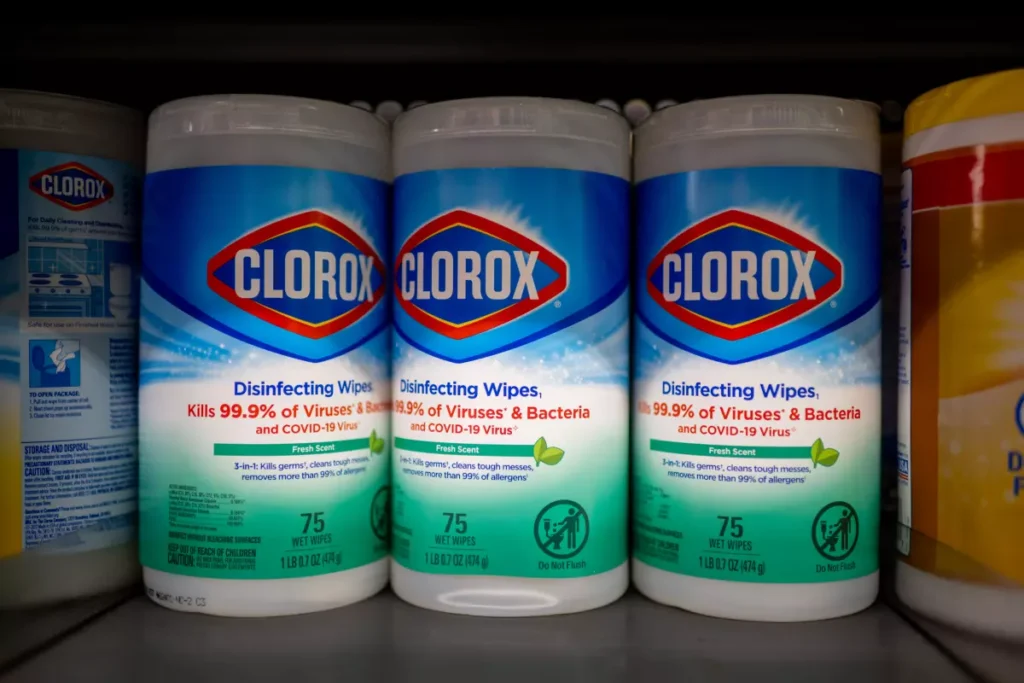
When you think about a company like Clorox, the stock market probably isn’t the first thing that comes to mind. You are more likely to think about household cleaning products, Glad trash bags, Fresh Step cat litter, or one of the many other brands you see on supermarket shelves.
And that is precisely what makes Clorox interesting from an investment perspective.
Behind a portfolio of seemingly unglamorous consumer products is a company that has been returning capital to shareholders for decades through dividends and share repurchases. For investors building an income-oriented portfolio, Clorox can therefore be an interesting case study.
But there is a catch.
In recent years, the business has faced a more challenging environment, with inflation, higher costs, increasingly price-conscious consumers, and pressure on margins. At the same time, the company has chosen to strengthen its portfolio through the acquisition of GOJO Industries, the owner of the Purell brand.
So the question is not simply how much Clorox’s dividend yields today.
The more important question is whether that dividend can continue to grow while the company navigates this period of transformation.
Clorox: An Enterprise That Is Bigger Than Its Name
Let’s start with something that is often overlooked.
Clorox is not simply the company behind the brand that carries its own name. Over the years, the group has built a broad portfolio of brands spanning household cleaning, health and wellness, personal care, and food.
There is Glad, Fresh Step, Kingsford, Hidden Valley, Brita, Burt’s Bees and, following the acquisition completed in April 2026, Purell.
This diversification matters because it reduces the company’s dependence on any single product. Even more importantly, many of these products belong to categories characterized by recurring consumer demand.
People can postpone buying a car, a smartphone, or a new television. It is much harder to completely stop buying trash bags, cleaning products, or personal hygiene items.
That doesn’t mean Clorox is immune to recessions. Consumers can switch to cheaper products, reduce consumption, or choose private-label alternatives. But underlying demand tends to be relatively resilient.
And that “boring” characteristic of the business is precisely what can appeal to a dividend investor.
The Dividend Is Clorox’s Main Attraction
The natural starting point for analyzing Clorox is its dividend.
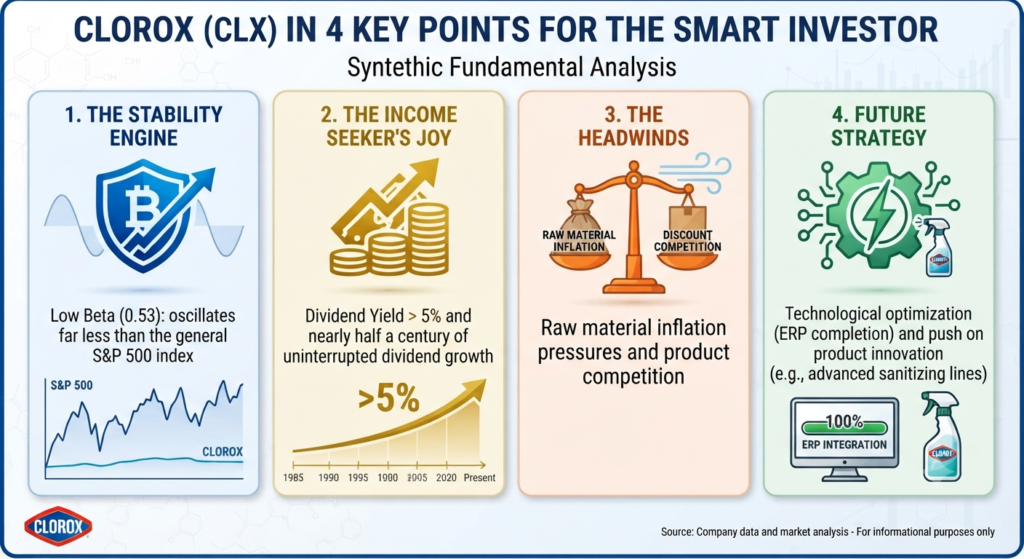
In July 2026, the company raised its quarterly dividend to $1.25 per share, bringing the annualized payout to $5 per share.
The increase was relatively modest, at just 0.8%, but the size of the increase is arguably less important than the consistency of the company’s distribution policy.
Clorox has now reached approximately 49 consecutive years of dividend growth.
For investors looking for companies capable of generating income over the long term, a track record like that matters.
Of course, a long history of increases does not guarantee that the future will look like the past.
And that is where the analysis becomes more interesting.
An investor should never stop at the question, “How much does Clorox pay?”
The more important question is where the money used to pay that dividend comes from.
If it comes from healthy growth in earnings and free cash flow, the situation is reassuring.
If the dividend is being maintained while earnings and cash flow deteriorate, the picture can become considerably more complicated.
The Dividend Matters, but Cash Flow Matters Even More
In fiscal 2025, Clorox generated approximately $981 million in operating cash flow and around $761 million in free cash flow.
These figures are important because they allow us to look at the company from a different perspective than simply focusing on net income.
Free cash flow represents, in simple terms, the cash left over after the investments needed to maintain and develop the business.
That cash can then be used to fund dividends, share buybacks, acquisitions, or debt reduction.
The problem is that Clorox went through a more difficult period in fiscal 2026.
In the fourth quarter of the fiscal year, sales declined by 2%, while net income fell significantly compared with the previous year.
That does not necessarily mean the business is in trouble.
A consumer company can go through a difficult year or two without compromising its long-term strategy.
However, for someone who owns Clorox primarily for its dividend, it is a signal that should not be ignored.
The dividend is still growing, but dividend growth needs to be supported by sufficiently strong growth in the company’s ability to generate cash.
That is the real issue.
And Then There Is the Buyback
If the dividend is the most visible part of shareholder returns, share buybacks are often the least understood.
Clorox has a $2 billion share repurchase program with no expiration date. As of March 31, 2026, approximately $876 million remained available under the program.
During the first nine months of fiscal 2026, the company also repurchased approximately 2.16 million shares for $254 million.
Why should investors care?
Because when a company buys back and retires its own shares, the total number of shares outstanding decreases.
Imagine a pie divided among 100 people.
If the number of people falls to 90 while the size of the pie remains unchanged, each person owns a larger slice.
In a publicly traded company, the “pie” represents earnings and free cash flow, while the shares represent the slices.
If Clorox can reduce its share count while maintaining or increasing earnings, each individual share can potentially benefit from a larger portion of those earnings.
Over time, that can translate into higher earnings per share and potentially a higher dividend per share.
But there is an important caveat.
Buybacks do not automatically create value.
If a company repurchases its own shares when the stock is significantly overvalued, it can spend a huge amount of money while generating a relatively small benefit.
The value of a buyback therefore depends partly on the price the company pays for its own shares.
Dividend and Buybacks Tell Two Different Stories
There is an interesting difference between these two forms of shareholder remuneration.
A dividend puts cash directly into the investor’s pocket.
A buyback works more indirectly.
If you own 100 Clorox shares and the company repurchases some of the shares outstanding, you still own 100 shares. But those 100 shares now represent a slightly larger percentage of the company.
That is why dividends and buybacks can be viewed as complementary tools.
The first is particularly attractive for investors who want current income.
The second can be more attractive for investors with a long-term horizon who prefer the company to reinvest part of its capital into its own stock.
For an investor who does not need to sell shares in the near term, the combination can be particularly powerful.
The Problem Is That Clorox Now Has to Decide Where to Allocate Its Capital
This brings us to the most delicate part of the story.
A company does not have unlimited resources.
Every dollar generated by the business has to be allocated somewhere.
It can be used to invest in growth, acquire another company, reduce debt, pay dividends, or repurchase shares.
Clorox currently has to manage all of these priorities at the same time.
On one hand, there is the dividend, which represents an important part of the company’s identity among investors.
On the other, there is the buyback program.
At the same time, the company needs to fund the investments required to improve the business and integrate GOJO.
And, of course, there is debt.
This means that over the next few years, the quality of capital allocation could be just as important as the company’s ability to sell more products.
Could Purell Change the Story?
Clorox completed its acquisition of GOJO Industries, the owner of Purell, on April 1, 2026.
The deal is interesting because it brings a well-known hygiene brand into the Clorox portfolio.
Strategically, the acquisition makes sense.
Purell allows Clorox to strengthen its position in a category that is broadly consistent with the rest of its portfolio.
But investors need to ask a different question.
It is not enough to ask whether Purell is a good brand.
The real questions are whether Clorox paid a reasonable price and whether it can turn the acquisition into higher free cash flow.
That is the difference between a good industrial acquisition and a good acquisition from a shareholder’s perspective.
If GOJO delivers growth and synergies, the transaction could become an important positive catalyst for Clorox.
If it requires more capital than expected or fails to generate the anticipated synergies, however, it could divert resources away from debt reduction or share repurchases.
The Biggest Risk for Dividend Investors
In my view, the biggest risk is not that Clorox will suddenly stop paying its dividend.
A company with a track record approaching half a century of consecutive dividend increases has a strong incentive to protect its reputation as a reliable dividend payer.
The more interesting risk is different:
growth could remain too weak for too long.
A company can continue paying a healthy dividend even without significant growth.
But if earnings remain stagnant, the payout gradually becomes more burdensome.
And when an increasingly large portion of cash flow is allocated to the dividend, less money is available for investments, acquisitions, debt reduction, and buybacks.
That can create a vicious cycle.
For this reason, an investor buying Clorox should focus much less on today’s dividend yield and much more on its sustainability over the next five or ten years.
Don’t Be Fooled by a High Dividend Yield
This is one of the most important rules when building a dividend portfolio.
A high yield does not automatically mean that a stock is cheap.
If a stock trades at $100 and pays a $5 annual dividend, the dividend yield is 5%.
If the stock falls to $80 while the dividend remains at $5, the yield rises to 6.25%.
That may look like good news.
But why did the market push the stock from $100 to $80?
It may simply be anticipating lower future earnings.
And if earnings continue to fall, that 6.25% yield may be much less secure than it appears.
That is why, when looking at Clorox, the dividend yield should only be the starting point of the analysis.
The real triangle to watch is:
dividend, free cash flow, and debt.
The buyback is the fourth element.
What Could Make Clorox Attractive Over the Next Few Years?
The bullish thesis is relatively straightforward.
Clorox has strong brands and a relatively defensive business. If the company can restore margins toward more normal levels, improve organic growth, and successfully integrate Purell, free cash flow could begin growing again.
At that point, the picture could become particularly attractive for shareholders.
Higher cash generation would allow the company to potentially fund a growing dividend, additional buybacks, and gradual debt reduction at the same time.
And this is where the real potential of the story lies.
Not in the roughly 5% annualized dividend yield alone.
But in the possibility that the amount of capital returned to shareholders continues to increase while the economic value represented by each individual share also grows.
And What Could Go Wrong?
The bearish scenario is just as easy to understand.
Consumers could continue shifting toward cheaper products. Inflation could keep costs elevated. Margins could remain under pressure.
Meanwhile, the integration of GOJO could take longer or require more capital than expected.
In that scenario, Clorox would probably continue paying its dividend, but it would have fewer resources available to increase it rapidly or conduct meaningful buybacks.
For an income-oriented investor, that would be a very different outcome from the ideal scenario.
The dividend might remain attractive, but dividend growth could become much slower.
And that distinction can have a significant impact over the long term.
Is Clorox a Good Dividend Stock?
My view is that Clorox is primarily a stock to watch closely, rather than a simple “buy it because the yield is high” story.
The company has one of the characteristics dividend investors value most: a long track record of dividend increases.
It also has a share repurchase program that, if used in a disciplined manner, could increase the share of earnings and cash flow attributable to each remaining share over time.
But today, the market is asking Clorox for something more.
It needs to demonstrate that the business can return to growth.
The Purell acquisition, margin recovery, and productivity initiatives will therefore be critical factors to watch.
For investors with a ten- or twenty-year horizon, the really interesting number will not be the dividend paid next quarter.
It will be the answer to a much more important question:
How large could that dividend be ten years from now?
The Real Question to Ask Before Buying CLX
Ultimately, investors should avoid asking only:
“What is Clorox’s dividend yield?”
A better question is:
“How much capital could Clorox return to me over the next ten years, and how sustainable is that policy?”
The difference may seem subtle, but it completely changes the way you analyze a dividend stock.
A company yielding 5% today but unable to grow may turn out to be less attractive than a company yielding 3% but growing its dividend by 7% or 8% per year.
Clorox sits somewhere between these two situations.
It has already built an impressive track record of returning capital to shareholders. Now it needs to prove that it can build the next phase of growth as well.
If it succeeds, dividends and buybacks could become two powerful engines of shareholder returns.
If growth remains weak, the dividend will probably continue to be the main reason to own the stock, but with a margin of safety that will need to be assessed much more carefully.
And that is precisely why Clorox is an interesting company to study for anyone building a dividend-focused portfolio: not because it is risk-free, but because it provides a clear example of how dividends, buybacks, debt, growth, and capital allocation are interconnected.
Data and information updated as of August 2026. This article is for informational purposes only and does not constitute financial advice or a recommendation to buy or sell CLX.